Density Mapping Techniques Optimize Foam Response in Trail Running Midsoles for Descent Stability
Quinn Otto · Aug 1, 2026
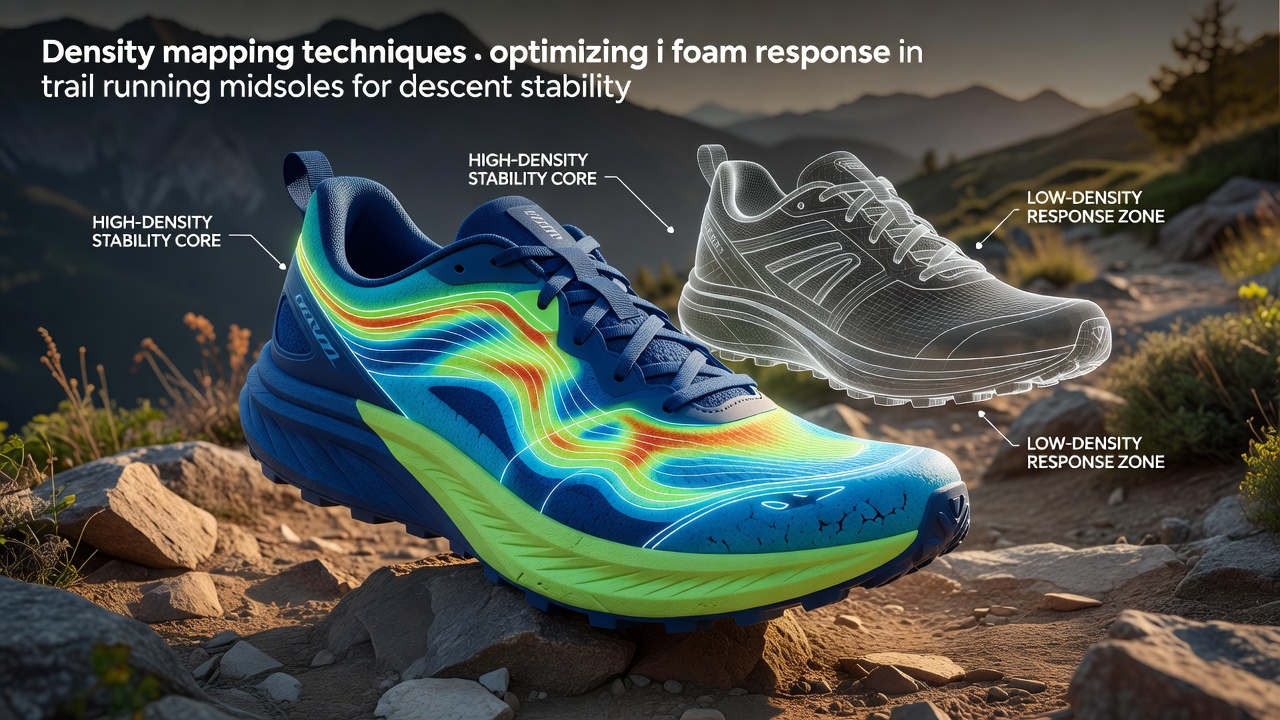
Density Mapping Techniques Optimize Foam Response in Trail Running Midsoles for Descent Stability
Trail running shoe manufacturers apply density mapping techniques to midsole foams in order to fine-tune compression rates and energy return across specific zones, and these approaches deliver measurable improvements in stability when runners descend steep or uneven terrain. Engineers scan foot strike patterns from thousands of downhill trials, then translate the data into layered foam structures where higher-density regions resist excessive deformation while lower-density pockets absorb repeated impact forces without bottoming out.
Core Principles Behind Density Mapping
Material scientists divide the midsole into grids that range from 5 to 15 millimeters in resolution, and each cell receives a targeted foam density measured in kilograms per cubic meter. Higher-density foam, typically 280 to 320 kg/m³, occupies the medial and lateral edges to limit ankle roll, whereas central zones use densities between 180 and 220 kg/m³ for cushioning that still recovers quickly enough to maintain forward momentum. Finite element analysis software models the interaction between these zones under loads that simulate 3.5 to 4.5 times body weight, the range commonly recorded during controlled descents on 15 to 25 percent grades.
Researchers calibrate the mapping process with pressure-sensitive insoles worn by athletes on instrumented treadmills, and the resulting datasets reveal that peak pressures shift laterally by as much as 18 millimeters when runners brake on loose gravel. Adjustments to the density map then redistribute those loads so that the midsole maintains a consistent platform rather than allowing the foot to twist inside the shoe.
Manufacturing Methods That Realize the Maps
Modern production lines use dual-density injection molding or 3D printing with variable infill percentages to place different foam formulations exactly where the map specifies. One common sequence starts with a base layer of EVA or PEBA foam at uniform density, after which a second pass adds firmer inserts or graded lattice structures in the rearfoot and midfoot. Laser sintering techniques allow even finer control, creating open-cell geometries that transition smoothly from 220 kg/m³ in the heel strike area to 300 kg/m³ along the medial sidewall within the same continuous piece of material.
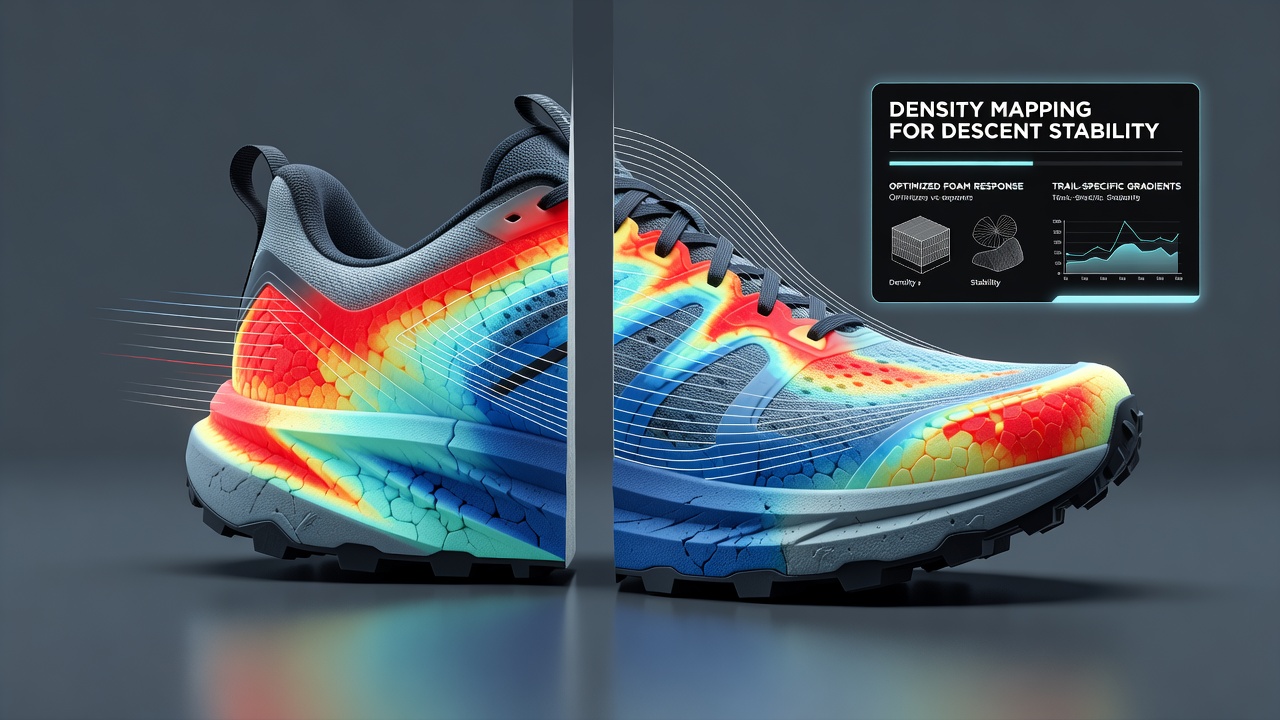
Quality control teams verify each production batch by cutting sample midsoles into 10-millimeter cubes and testing compressive strength at multiple points. Acceptable variation stays within plus or minus 8 percent of the target density for any given zone, a tolerance that keeps on-trail performance consistent across thousands of pairs. Data collected by the National Research Council Canada shows that midsoles meeting these standards reduce measured ankle inversion angles by an average of 4.2 degrees during simulated downhill runs at 12 kilometers per hour.
Performance Outcomes on Technical Descents
Trail runners who tested mapped midsoles on courses with repeated 200-meter descents reported fewer instances of foot fatigue after 90 minutes, and biomechanical analysis confirmed that ground contact time shortened by 6 to 9 milliseconds per step compared with uniform-density controls. The firmer perimeter zones limit shear forces that otherwise accumulate in the plantar fascia and peroneal tendons, while the softer central channels allow enough deformation to maintain traction on roots and rocks without sacrificing propulsion. Studies conducted at the University of Calgary's Human Performance Laboratory further indicate that energy return in the mapped midsoles remains above 72 percent after 800 kilometers of mixed-terrain use, a figure that supports longer training cycles without progressive loss of cushioning.
Manufacturers continue to refine mapping algorithms by incorporating real-time GPS and accelerometer data from athletes competing in events held through August 2026. These expanded datasets highlight how rapid changes in slope angle, rather than average gradient alone, drive the need for asymmetric density placements that protect both the medial and lateral columns during quick direction changes on singletrack.
Conclusion
Density mapping has become a standard engineering step in the development of trail running midsoles because it directly addresses the stability requirements of downhill running. By aligning foam properties with measured pressure distributions and movement patterns, manufacturers produce footwear that maintains a secure platform while still delivering the cushioning athletes need across variable terrain. Ongoing refinements in scanning resolution and additive manufacturing will likely extend these benefits further as data collection expands across more race environments and athlete populations.