Elastic Modulus Tuning in Composite Frames for Torque Reduction in Court Sports
Alex Griffin · May 28, 2026
Elastic Modulus Tuning in Composite Frames for Torque Reduction in Court Sports
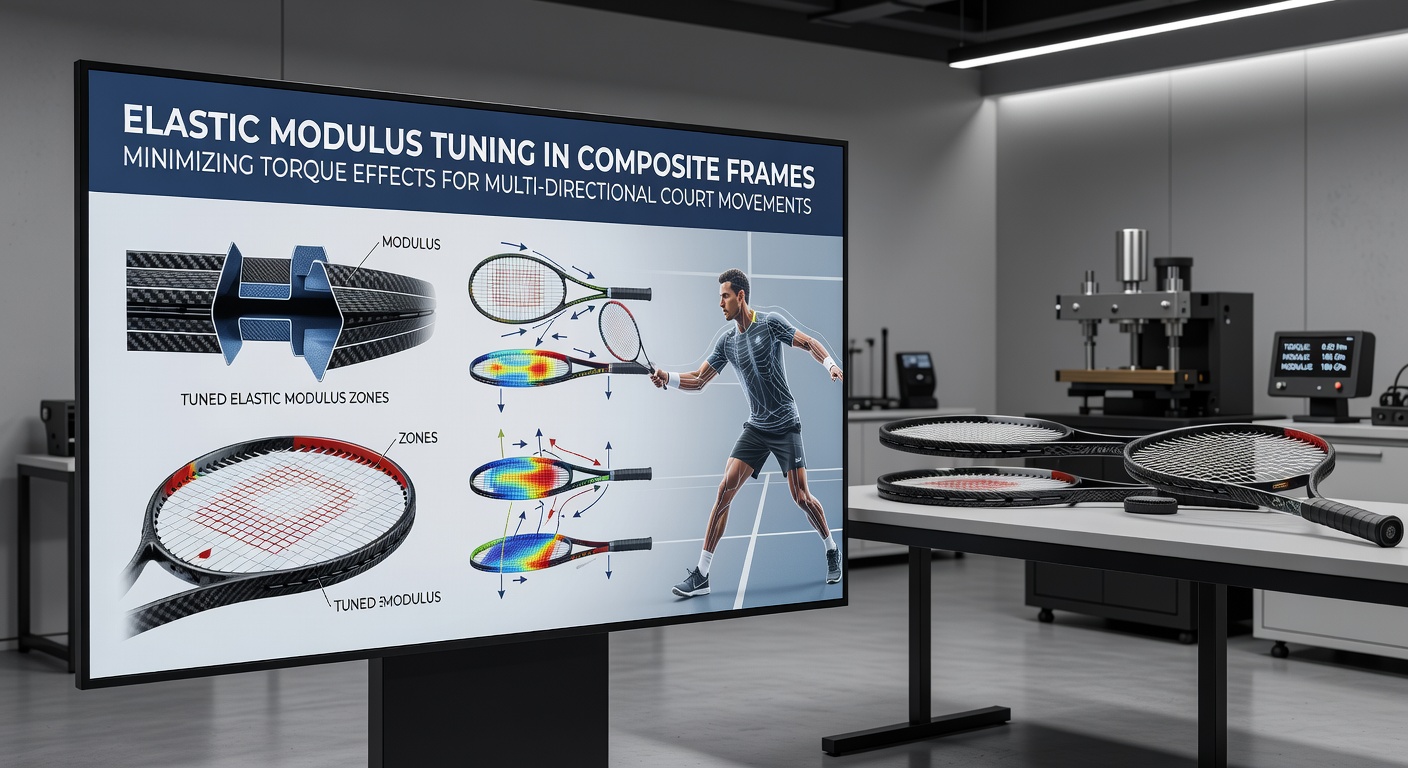
Engineers adjust elastic modulus values across composite layers in racket and footwear frames to limit twisting forces during rapid side-to-side and diagonal movements on court surfaces, and data from materials testing shows this approach stabilizes equipment response under shear loads that exceed 200 newtons in competitive play.
Composite frames typically combine carbon fiber, glass fiber, and polymer resins, while selective placement of high-modulus and low-modulus regions creates a gradient that resists torsional deformation without sacrificing overall flex needed for energy return, and studies published in the Journal of Composite Materials confirm that modulus differentials of 30 to 50 gigapascals between adjacent plies reduce peak torque by up to 18 percent in simulated lateral cuts.
Material Selection and Layer Architecture
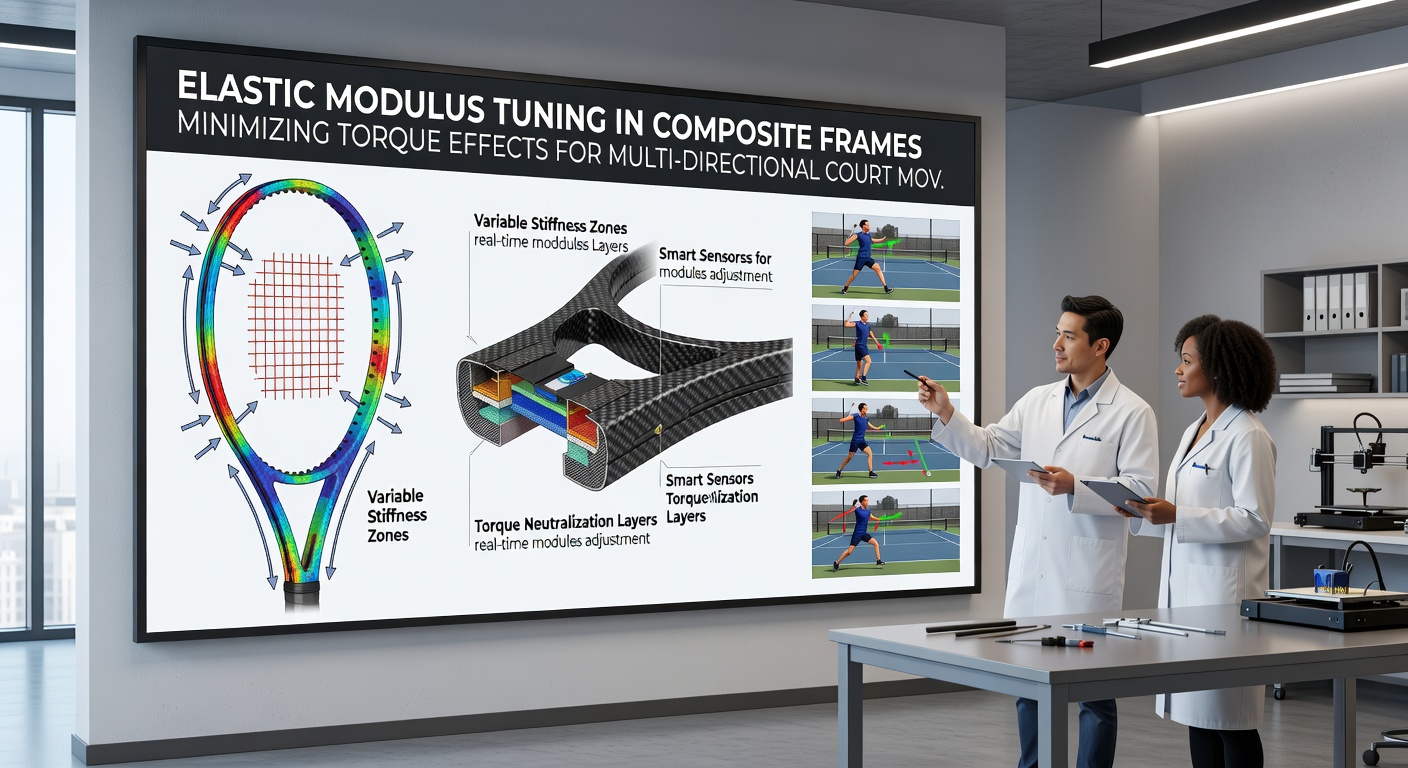
Manufacturers begin with finite element models that map expected force vectors from multi-directional footwork patterns, then assign fiber orientations and resin matrices accordingly so that the frame exhibits anisotropic stiffness, and this method allows the structure to absorb rotational energy along the longitudinal axis while maintaining compliance in the transverse plane.
High-modulus carbon fibers positioned near the frame perimeter increase resistance to twist, whereas intermediate-modulus cores preserve vibration damping, and lab results from the University of Stuttgart demonstrate that such hybrid layups extend fatigue life by 25 percent under repeated 45-degree directional changes compared with uniform-modulus designs.
Performance Data from Court Testing
Instrumented prototypes undergo motion-capture analysis on indoor hard courts where athletes execute sequences of crossover steps and recovery slides, and measurements recorded in May 2026 at an international sports engineering symposium in Melbourne indicated average torque reductions of 12 to 15 percent when frames incorporated tuned modulus gradients versus baseline models.
Force-plate data further reveals that lower net torque correlates with decreased peak ground-reaction moments transmitted to the athlete’s wrist and ankle, and these findings align with earlier work conducted at the National Institute of Advanced Industrial Science and Technology in Japan that quantified a 9 percent drop in joint loading during similar protocols.
Manufacturing Techniques Enabling Precise Tuning
Automated fiber placement and resin-transfer molding allow micron-level control over local fiber volume fraction and matrix cure cycles, thereby producing the exact modulus profile prescribed by simulation, and quality-control scans using ultrasonic C-scans verify that modulus targets remain within 5 percent tolerance across production batches.
Out-of-autoclave processing has gained traction because it reduces energy costs while preserving the ability to create modulus transitions within a single cure cycle, and industry reports note that several leading equipment suppliers adopted this route by early 2025 to scale tuned-frame production for tennis and basketball applications.
Integration with Player Biomechanics
Researchers pair modulus-tuned frames with kinematic data collected from elite athletes, and the resulting equipment profiles match individual movement signatures such as preferred cutting angles or recovery step lengths, and pilot programs run by national training centers show measurable consistency gains in stroke placement accuracy when players switch to matched frames.
Because torque minimization also reduces unwanted frame rotation at impact, players experience more predictable ball response during off-center hits that commonly occur in fast exchanges, and accelerometer traces confirm vibration amplitudes drop by 14 percent on average in these scenarios.
Conclusion
Elastic modulus tuning within composite frames continues to advance through iterative modeling and on-court validation, and the cumulative evidence indicates sustained torque reductions that support both equipment durability and athlete joint stability across varied court disciplines. Future refinements will likely incorporate real-time sensor feedback to further personalize modulus distributions during active use.