Road Bike Frame Geometry Tweaks That Boost Power on Climbs and Flats
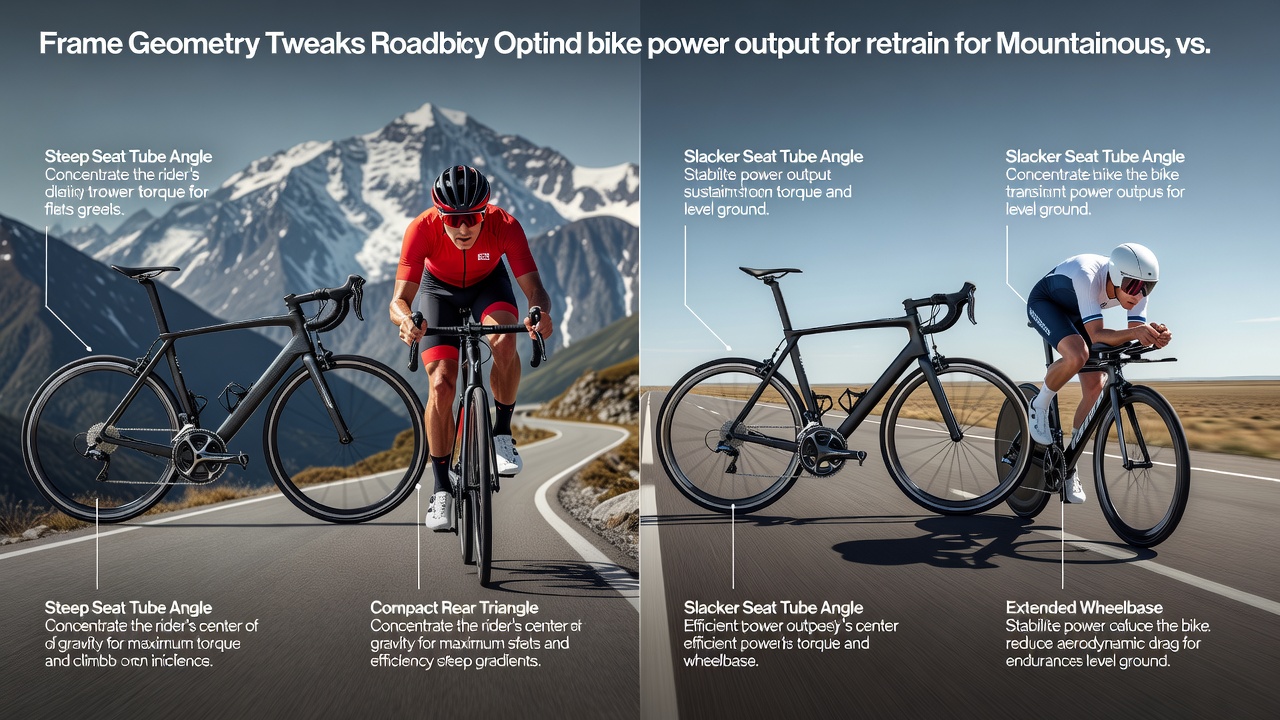 Frame geometry adjustments in road bikes allow engineers to modify power delivery by altering angles, lengths, and proportions within the frame structure. These changes influence how force from the rider transfers to the pedals across different surfaces. Manufacturers adjust parameters such as seat tube angle, head tube angle, chainstay length, and bottom bracket drop to suit specific riding demands. Data from performance testing indicates that steeper seat tube angles often improve hip angle alignment during seated climbs, which supports consistent force application on steep gradients. Riders tackling mountainous routes frequently encounter sustained efforts at low cadences. In these conditions, frames with chainstays shortened by 5 to 10 millimeters relative to endurance models reduce flex under high torque loads. This configuration transmits more of the applied power directly to the rear wheel. Observers note that a 73-degree seat tube angle positions the rider farther forward over the bottom bracket, which aligns the knee over the pedal spindle at the power stroke peak. Engineers at major brands have documented efficiency gains of 2 to 4 percent in laboratory wattage measurements when comparing these steeper geometries against more relaxed setups on simulated 8 percent grades. Flat terrain presents different requirements centered on sustained aerodynamic positioning and reduced frontal resistance. Here, longer wheelbases created by extended chainstays of 410 millimeters or more promote stability at higher speeds. A slacker head tube angle around 71.5 degrees increases trail measurement, which dampens steering input during crosswinds while allowing the rider to maintain a low torso angle. Research from the University of Calgary's Human Performance Laboratory shows that these relaxed geometries help preserve average power output over 40-kilometer time trials by minimizing upper body oscillation.
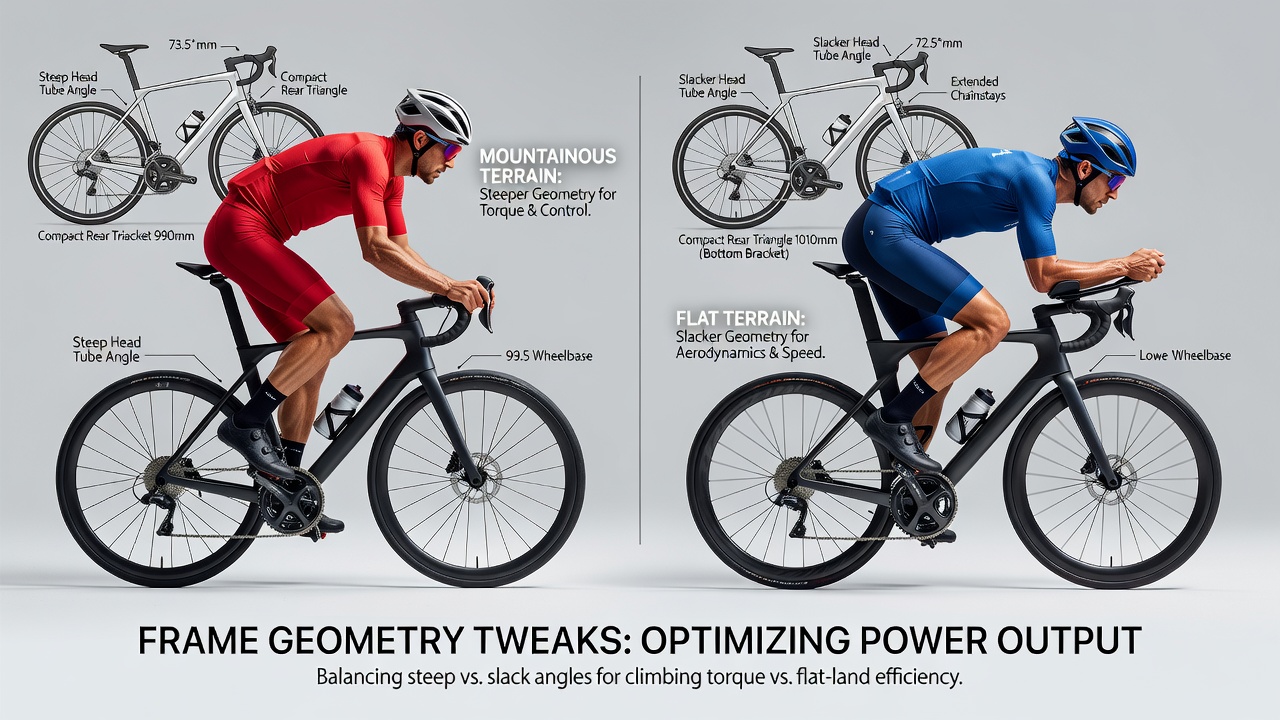 Wheelbase length further differentiates the two setups. Mountain-oriented frames often measure between 980 and 1000 millimeters, which shortens the distance between contact patches and quickens weight shifts during out-of-saddle accelerations. Flat-terrain frames extend beyond 1010 millimeters, which stabilizes the bike under sustained high-cadence pedaling and reduces energy lost to steering corrections. These measurements appear consistently in professional peloton equipment lists published ahead of major stage races.
Frame geometry adjustments in road bikes allow engineers to modify power delivery by altering angles, lengths, and proportions within the frame structure. These changes influence how force from the rider transfers to the pedals across different surfaces. Manufacturers adjust parameters such as seat tube angle, head tube angle, chainstay length, and bottom bracket drop to suit specific riding demands. Data from performance testing indicates that steeper seat tube angles often improve hip angle alignment during seated climbs, which supports consistent force application on steep gradients. Riders tackling mountainous routes frequently encounter sustained efforts at low cadences. In these conditions, frames with chainstays shortened by 5 to 10 millimeters relative to endurance models reduce flex under high torque loads. This configuration transmits more of the applied power directly to the rear wheel. Observers note that a 73-degree seat tube angle positions the rider farther forward over the bottom bracket, which aligns the knee over the pedal spindle at the power stroke peak. Engineers at major brands have documented efficiency gains of 2 to 4 percent in laboratory wattage measurements when comparing these steeper geometries against more relaxed setups on simulated 8 percent grades. Flat terrain presents different requirements centered on sustained aerodynamic positioning and reduced frontal resistance. Here, longer wheelbases created by extended chainstays of 410 millimeters or more promote stability at higher speeds. A slacker head tube angle around 71.5 degrees increases trail measurement, which dampens steering input during crosswinds while allowing the rider to maintain a low torso angle. Research from the University of Calgary's Human Performance Laboratory shows that these relaxed geometries help preserve average power output over 40-kilometer time trials by minimizing upper body oscillation.Key Geometry Parameters and Their Effects
Several frame dimensions interact to shape power transfer. Stack and reach measurements determine handlebar height and reach distance, which influence torso angle and shoulder loading. Lower stack heights combined with longer reaches encourage forward weight distribution on flats, reducing aerodynamic drag without sacrificing pedal force. On climbs, higher stack values paired with shorter reaches allow upright postures that maintain breathing efficiency during prolonged efforts. Bottom bracket drop affects pedal clearance and handling responsiveness. A drop of 70 millimeters provides sufficient cornering clearance on winding mountain roads while keeping the center of gravity low enough for stable power application. Manufacturers often increase this drop to 75 millimeters in endurance frames designed primarily for flat or rolling routes, which lengthens the effective wheelbase slightly and improves straight-line tracking.Terrain-Specific Adjustments in Practice
Teams and fitters analyze rider data from power meters and motion capture systems to select geometry packages. One study released by Cycling Canada in 2025 tracked 48 competitive riders across both alpine stages and prairie time trials. Riders using frames with adjustable rear dropouts that shortened chainstays by 8 millimeters recorded higher peak power outputs during 20-minute threshold climbs, whereas the same riders switched to extended chainstay positions for flat-stage efforts and maintained higher average speeds with lower heart rate variability.
Wheelbase length further differentiates the two setups. Mountain-oriented frames often measure between 980 and 1000 millimeters, which shortens the distance between contact patches and quickens weight shifts during out-of-saddle accelerations. Flat-terrain frames extend beyond 1010 millimeters, which stabilizes the bike under sustained high-cadence pedaling and reduces energy lost to steering corrections. These measurements appear consistently in professional peloton equipment lists published ahead of major stage races.