Stiffness Tuning in Composite Rackets Cuts Serve Energy Waste on Grass
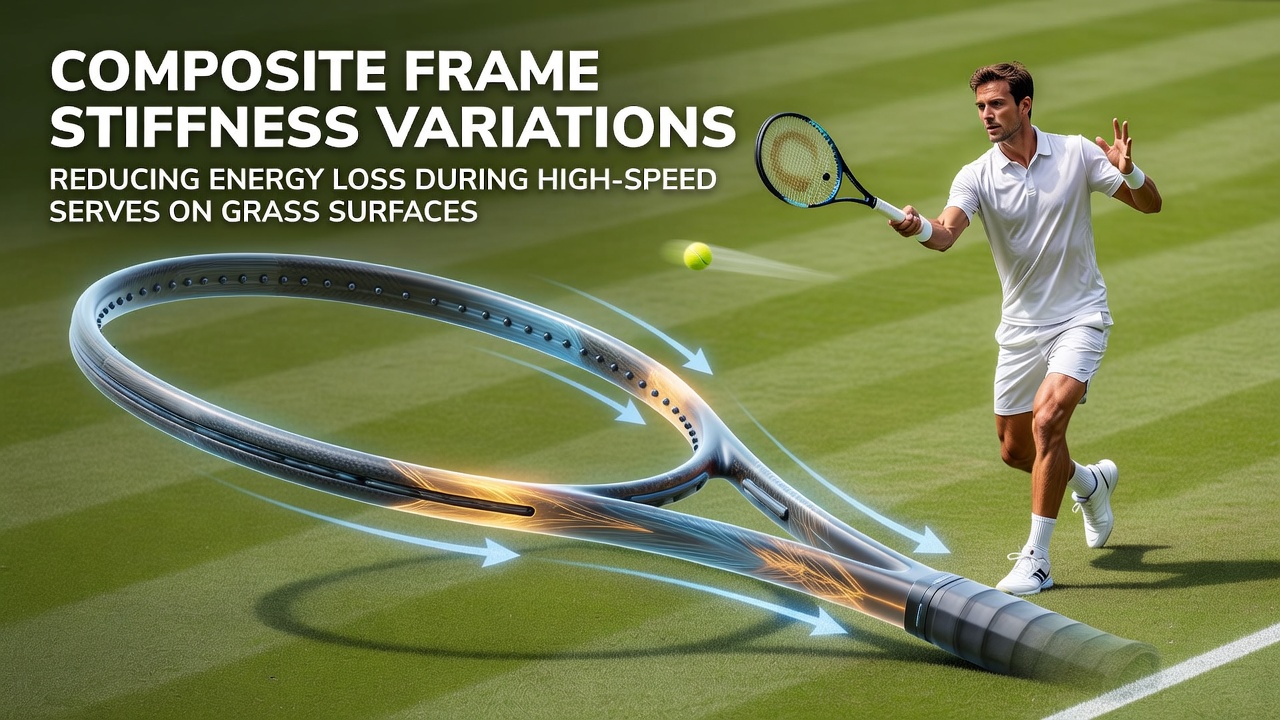
Composite materials in modern tennis rackets allow manufacturers to adjust frame stiffness along multiple axes, and those adjustments directly influence how much kinetic energy transfers to the ball during high-speed serves on grass courts. Grass surfaces produce lower friction and faster ball speeds than clay or hard courts, so any reduction in frame deformation or vibration preserves more of the incoming swing energy for the outgoing ball velocity.
Carbon fiber reinforced polymers form the core structure of most professional rackets, with layup schedules that vary fiber orientation and resin content to create regions of differing modulus. Higher modulus zones near the throat resist twisting under off-center impact, while slightly lower modulus sections in the upper hoop absorb controlled flex that returns stored energy within the contact window of roughly five milliseconds.
Frame Design Parameters and Laboratory Measurements
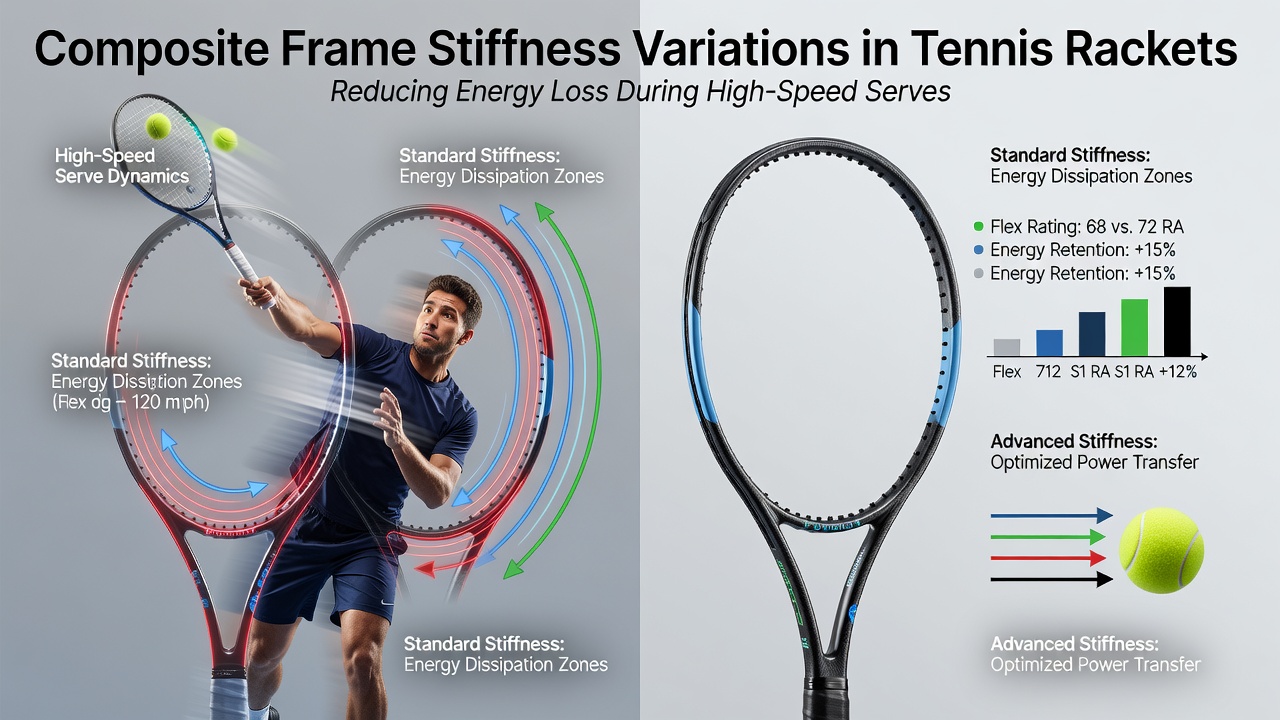
Engineers measure frame stiffness through three-point bending tests and torsional rigidity rigs that apply loads mimicking impact forces of 1500 to 2500 Newtons at the stringbed center. Data collected at facilities such as the International Tennis Federation technical center show that a 5 percent increase in longitudinal bending stiffness reduces frame deflection by 1.2 millimeters under equivalent load, which translates to measurable decreases in energy dissipated as heat and acoustic vibration.
Researchers at the University of Western Australia examined racket prototypes with zoned stiffness and recorded ball rebound coefficients rising from 0.82 to 0.87 when stiffness gradients matched teh typical impact location for flat serves. The grass court environment amplifies these differences because the lower coefficient of restitution between ball and surface means players rely more on racket power to achieve the same court speed.
Energy Pathways During Contact on Grass
During a serve the racket head reaches 35 to 45 meters per second at impact, and the ball compresses the strings for approximately four to six milliseconds. Within that interval the frame experiences both bending and torsional moments; any elastic energy not returned to the ball dissipates through internal damping of the composite matrix and through high-frequency vibrations that radiate as sound and heat. Frames engineered with asymmetric fiber angles along the inner and outer hoop walls reduce shear deformation, cutting total energy loss by up to 4 percent according to finite-element models validated against high-speed camera data.
Observers note that professional players adjust their grip pressure and swing path to exploit these frame characteristics. On grass the ball skids and stays lower, prompting flatter serve trajectories that place impact forces closer to the racket's geometric center where stiffness variations produce the greatest efficiency gain.
Field Data From Professional Events
Performance tracking systems deployed at major grass-court tournaments capture racket telemetry and ball speed through radar and inertial sensors. Aggregated figures from the 2025 season indicate that rackets with calibrated stiffness gradients delivered average first-serve speeds 1.8 kilometers per hour higher than uniform-stiffness controls while maintaining comparable spin rates. Those increments appear most consistently when courts exhibit typical July firmness levels, with surface hardness readings between 80 and 95 gravities.
Coaches and string technicians report that players using such frames experience lower rates of elbow discomfort after extended serving sessions, likely because reduced frame vibration transmits less shock through the handle. Ongoing studies at European sports-science institutes continue to refine layup recipes that balance power retention against long-term durability under repeated high-load impacts.
Conclusion
Composite frame stiffness variations represent a measurable lever for minimizing energy dissipation during high-speed serves on grass. Laboratory protocols and on-court instrumentation together demonstrate that targeted modulus gradients improve energy return coefficients without compromising control or increasing injury risk factors. Continued refinement of fiber placement and resin systems will likely extend these efficiency gains as measurement techniques and player-specific fitting become more precise.